
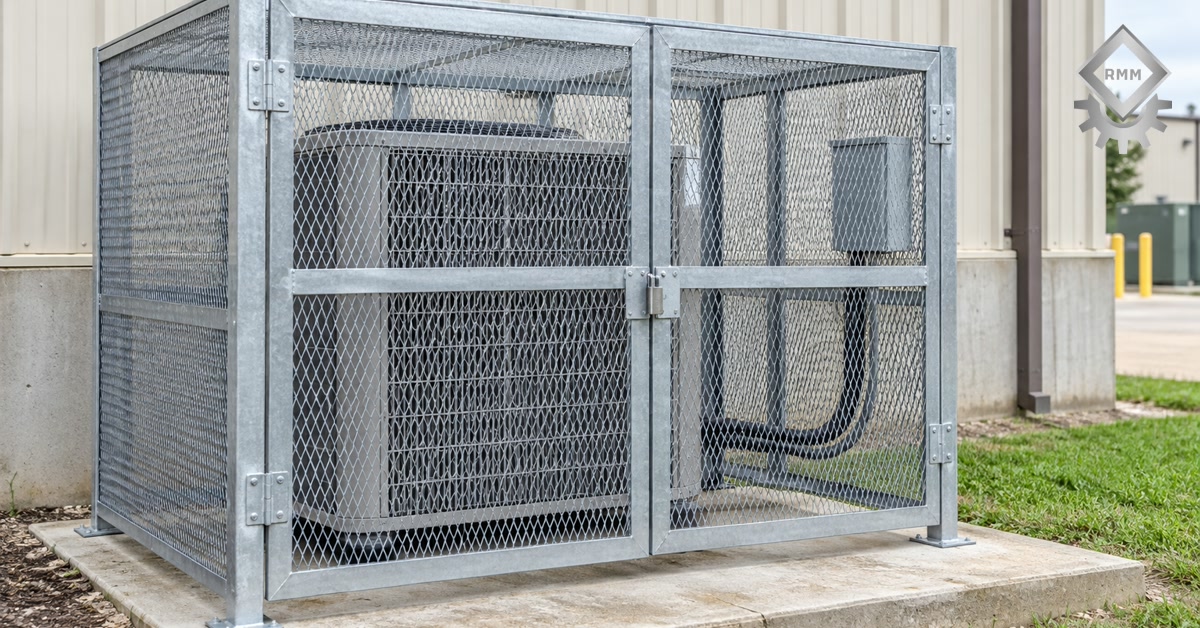
When someone strips the copper out of an outdoor condenser, the property is left with a unit that will not run and a repair nobody planned for. At Reese Marine & Manufacturing we fabricate protective cages for property managers and facilities buyers dealing with that risk across a portfolio. This post covers what a thief reaches for on a condenser, which parts of a cage close that off and what we need before we cut steel.
Where the copper sits on a condenser
An outdoor condenser carries its copper in a few places, and most of it sits exposed. The refrigerant line set enters the cabinet at the service valves, a pair of tubes running along the outside of the unit with nothing over them. Inside the cabinet, the coil holds run after run of copper tube behind a thin fin pack. The electrical side matters too, since the disconnect, the whip and the contactor usually sit outside the cabinet and hold copper of their own.
We draw every cage around that list. Our flat bar cages enclose the condenser, the refrigerant lines and the exposed mechanical or electrical components. The louvered and puck lock lines cover the same ground in different materials.
| Part of the unit | Where the copper sits | What closes it off |
|---|---|---|
| Refrigerant line set and service valves | Copper tube running in the open along the side of the cabinet | An enclosure that carries past the valves so the lines sit inside the cage |
| Condenser coil | Copper tube behind a thin fin pack inside the cabinet | A welded frame that has to be cut before the cabinet is reachable |
| Disconnect, whip and contactor | Copper wire, plus the parts that let the unit start | Panels sized to the whole installation instead of the equipment footprint |
| The cage lock | An exposed padlock shackle is the classic weak point on any enclosure | A lock with nothing sticking out for a bolt cutter to bite |
Does a cage stop copper theft?
A cage does not make an HVAC unit theft proof. What it does is take away the quick, quiet grab: getting through welded steel takes cutting tools, noise and time standing in the open, and that is enough to send most trouble elsewhere.
The copper itself is the cheap part of a theft. A cut line set empties the system, so the repair starts with a certified technician recovering what is left, brazing in new line, pulling a vacuum and recharging. If the coil is gone, the condenser goes with it, and a replacement has to be ordered while tenants keep calling.
Cutting into a charged line set vents the refrigerant. Under Section 608 of the Clean Air Act, EPA regulations (40 CFR Part 82, Subpart F) prohibit intentionally venting refrigerants while servicing, repairing or disposing of air-conditioning equipment. Only EPA-certified technicians may buy the refrigerant to recharge the system.
If you have units sitting open on a pad right now, send us dimensions and a few photos and we will price a cage against them. Call us at (251) 591-9188, or look through the cages we build for HVAC equipment first.
Matching the cage to the property
Three of our lines end up over HVAC equipment, and which one fits depends more on the property than the unit.
Louvered HVAC cages go where somebody has an opinion about how the equipment looks. They are lightweight aluminum with custom powder coating, so the color can be matched to the building. Condo boards and municipal codes are the usual reason a property manager calls about them, and we went through what condo and HOA boards ask for earlier this summer.
Flat bar cages are the working-property choice. We galvanize them instead of powder coating them, and the heat-treated corners hold the frame square once it is anchored. The install is streamlined compared with our main cage systems, which matters when the job is twenty condensers instead of one.
Puck lock vandal cages answer the case where the lock is the weak point. The concealed hasp eliminates access points once the cage is closed, so there is no shackle sitting out to cut. We build them for remote sites, back lots and critical infrastructure. The same fabrication runs through our snow and ice shields, cell tower security cages and utility and wall mounted cages.
Numbers we need before we cut steel
Every cage is fabricated to the equipment it goes over, so a quote starts with measurements rather than a catalog page. Send us:
- Unit dimensions, or the make and model off the data plate if that is easier
- Pad size, and how much room sits between the unit and the wall
- Where the line set and the disconnect enter, and which side your technician works from
- What the cage will anchor into
- Anything the property requires on color, height or screening
We cut and weld to those numbers in our own shop. A cage sized off a guess leaves a gap where the lines run out, or lands so tight the service panel will not clear. Either way you get a call from the crew standing in front of it.
Common questions about HVAC copper theft cages
Will a security cage make an HVAC unit run hot?
Not if the cage is built to pass air. The louvered line uses angled slats that keep air moving through the unit, and the flat bar and puck lock designs are open frames rather than solid panels. Airflow is one of the constraints we size to, alongside service clearance.
Can technicians still service a unit inside a cage?
Yes. Our louvered cages use slide-out side panels and a removable door, which keeps all sides accessible for coil cleaning and diagnostics. Tell us how your crew works before we build, and we will size the access around it.
Is a custom cage necessary, or will an adjustable kit do?
A kit can work when the equipment is a standard size and the fit is nobody’s concern. We fabricate each cage to the unit it protects, which is what lets the frame sit tight to the pad and still clear the service side. On a property with mixed equipment we work from the dimensions of each unit type.
Do you build for properties outside the Gulf Coast?
Regularly. We fabricate on the Gulf Coast and ship across the United States and beyond, and portfolio orders are normal for us. Freight and install details get worked out with the quote.
Get a cage priced for your units
Send us the unit dimensions and a couple of photos of the pad, and we will come back with a cage designed around them. Our shop is in Daphne, Alabama. Call Reese Marine & Manufacturing at (251) 591-9188 or email info@reesecages.com, and tell us how many units you are looking at.


